

Water infiltration rarely stays confined to the place where it first appears. A leak through an exterior plaza, parking deck, terrace, or other occupied structure can migrate through joints, cracks, drains, and transitions before it becomes visible below. By that point, the problem may extend beyond the surface finish and into the waterproofing system, concrete, reinforcing steel, drainage components, and surrounding hardscape.
That risk is becoming harder for New Jersey property owners to treat as an isolated maintenance concern. The state is experiencing heavier rain events, recurring flash flooding, and more frequent coastal flooding. Commercial properties need exterior systems that can manage that exposure without allowing water to reach vulnerable structural components.
New Jersey’s Flood Exposure Is Changing
The pattern was visible again in July, when ABC7 reported flash flooding in New Brunswick, Matawan, Edison, and Keyport. The storm closed roads, submerged vehicles, and brought another round of disruption to communities across Central New Jersey.
In May 2026, NJ Spotlight News reported that sunny-day flooding is becoming more common in Shore communities. This type of flooding can occur during high tides without a major coastal storm, adding another source of recurring water exposure for properties near the coast.
The concern extends well beyond tidal areas. Rutgers University’s May 2026 State of the Climate: New Jersey 2025 report found that total annual rainfall in New Jersey has increased approximately 7% since the early 1900s. The report also states that extreme precipitation events have become more frequent and projects a 5% to 15% increase in extreme 24-hour rainfall under a moderate-emissions scenario.
For commercial properties, these trends increase the demands placed on plaza decks, parking structures, building entrances, elevated walkways, drainage systems, and other exposed assemblies. A system that performed adequately under past conditions may now face water more often, in greater volume, or for longer periods.
What the OceanFirst Bank Plaza Restoration Revealed
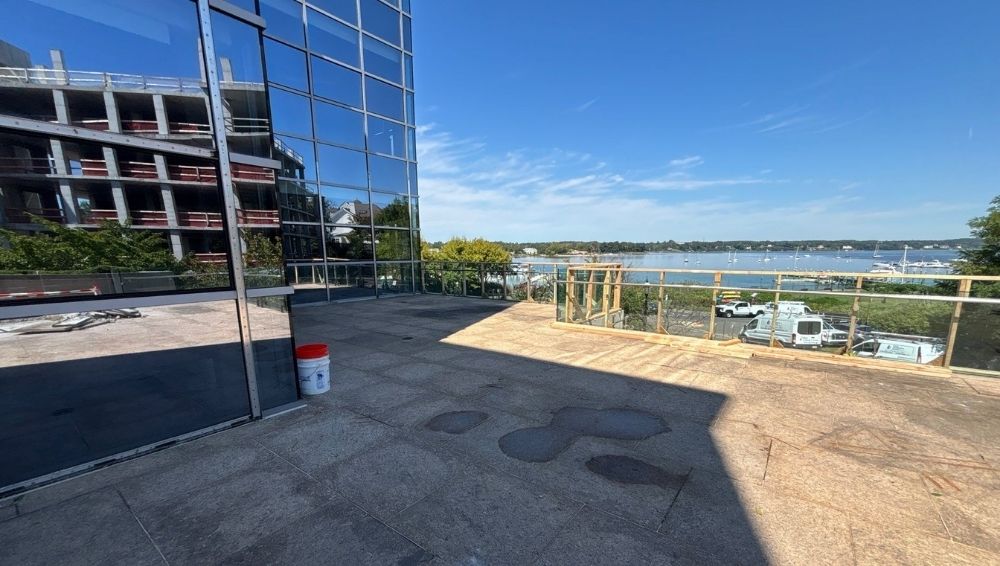
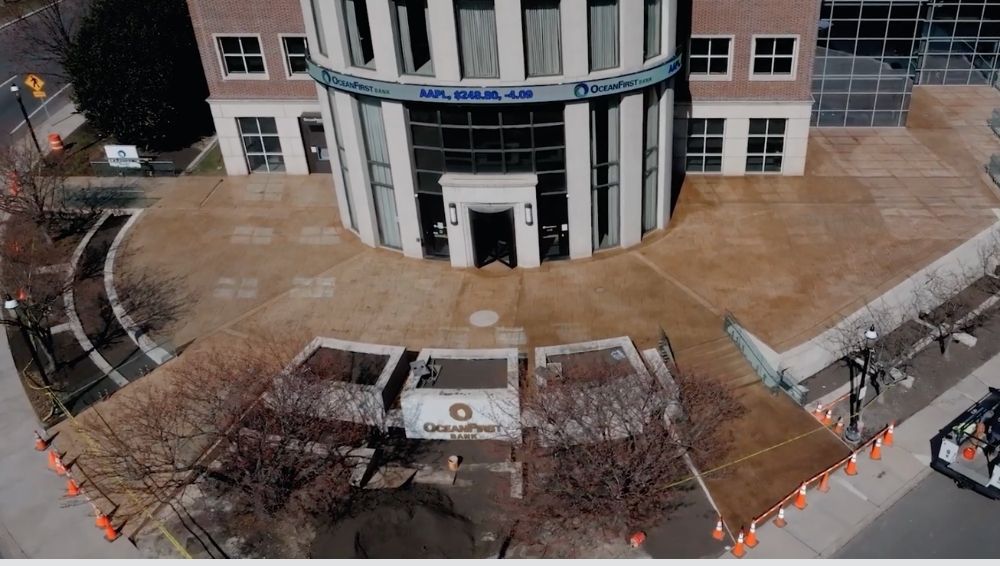
The exterior plaza deck at OceanFirst Bank in Red Bank required more than a localized waterproofing repair. Eliminating the source of water infiltration meant addressing the plaza as a complete assembly.
T.G. Basile’s work included:
- Concrete repairs to restore deteriorated areas and provide a sound substrate
- Waterproofing to create a continuous barrier against water penetration
- Drainage improvements to move water away from the plaza more effectively
- Plaza reconstruction to restore the complete walking surface
- Stone restoration to preserve and reintegrate existing architectural materials
- Traffic coatings to protect exposed surfaces from continued use and weather
- Site hardscape improvements to support drainage and enhance long-term performance
Each part of the project supported the same objective. The plaza needed to shed water, protect the structure below, remain functional for the property, and provide a finished result appropriate for a customer-facing commercial location.
Watch the OceanFirst Bank plaza restoration video to see how the project came together.
Why Surface Repairs Often Fall Short
The point where water becomes visible is not always the point where it entered. Water can travel laterally beneath pavers, follow reinforcing steel, move through cold joints, or collect around penetrations and drains. Repairing only the visible crack or damaged finish can leave the underlying route untouched.
Several conditions may be contributing to the same infiltration problem:
- Failed or discontinuous waterproofing membranes
- Cracked, spalled, or delaminated concrete
- Deteriorated joints and sealants
- Poor slopes that allow water to pond
- Blocked, undersized, or poorly positioned drainage
- Transitions between stone, concrete, walls, doors, and penetrations
- Corrosion of embedded reinforcing steel after repeated moisture exposure
These conditions need to be evaluated together. Otherwise, a property owner may pay for repeated repairs while water continues to move through another part of the assembly.
Restoration Must Rebuild Performance
A comprehensive restoration project starts with understanding how the existing plaza or deck was constructed, where it has failed, and how water is moving through it. The repair scope can then address damaged materials while rebuilding the waterproofing and drainage functions the property depends on.
Execution matters just as much as the selected materials. Existing surfaces must be removed without creating unnecessary damage. Concrete repairs need proper preparation and curing. Waterproofing must remain continuous across joints, penetrations, drains, edges, and vertical transitions. Reconstructed stone and hardscape must support the intended drainage plan instead of directing water back toward the building.
On an occupied commercial property, all of this must also be coordinated around access, public protection, tenant or customer activity, deliveries, and business operations. That requires disciplined phasing and field control from demolition through final reconstruction.
A More Important Capital Planning Question
The increasing frequency of New Jersey flooding does not mean every exterior plaza or parking deck requires immediate reconstruction. It does mean that recurring leaks, ponding water, deteriorated joints, loose stone, concrete spalling, and staining below an exposed deck should not be treated as unrelated symptoms.
The better question is whether the complete system is still managing water as intended. Answering that question early gives property owners more control over investigation, repair priorities, budgeting, sequencing, and scheduling. Waiting until infiltration damages occupied space or accelerates concrete deterioration can significantly expand the scope.
Restore the System, Not Just the Surface
The OceanFirst Bank project demonstrates what effective water-infiltration restoration requires. Concrete repairs, waterproofing, drainage, coatings, stonework, and hardscape improvements were coordinated as parts of one system rather than separate cosmetic fixes.
With more than 50 years of concrete and restoration experience, T.G. Basile helps commercial property owners address complex exterior deterioration with the planning, coordination, and field execution these projects demand. Contact T.G. Basile to discuss a plaza deck, parking structure, façade, or other water-infiltration concern.