

Not all structural concrete damage is visible. In parking garages, some of the most serious structural deterioration happens beneath the surface, where it can go undetected for years.
By the time spalling or cracking becomes obvious to the naked eye, the underlying problem has often spread well beyond the visible area. That gap between what you can see and what’s actually happening inside the slab is exactly why chain dragging remains one of the most important first steps in any parking garage restoration project.
What Chain Dragging Actually Does
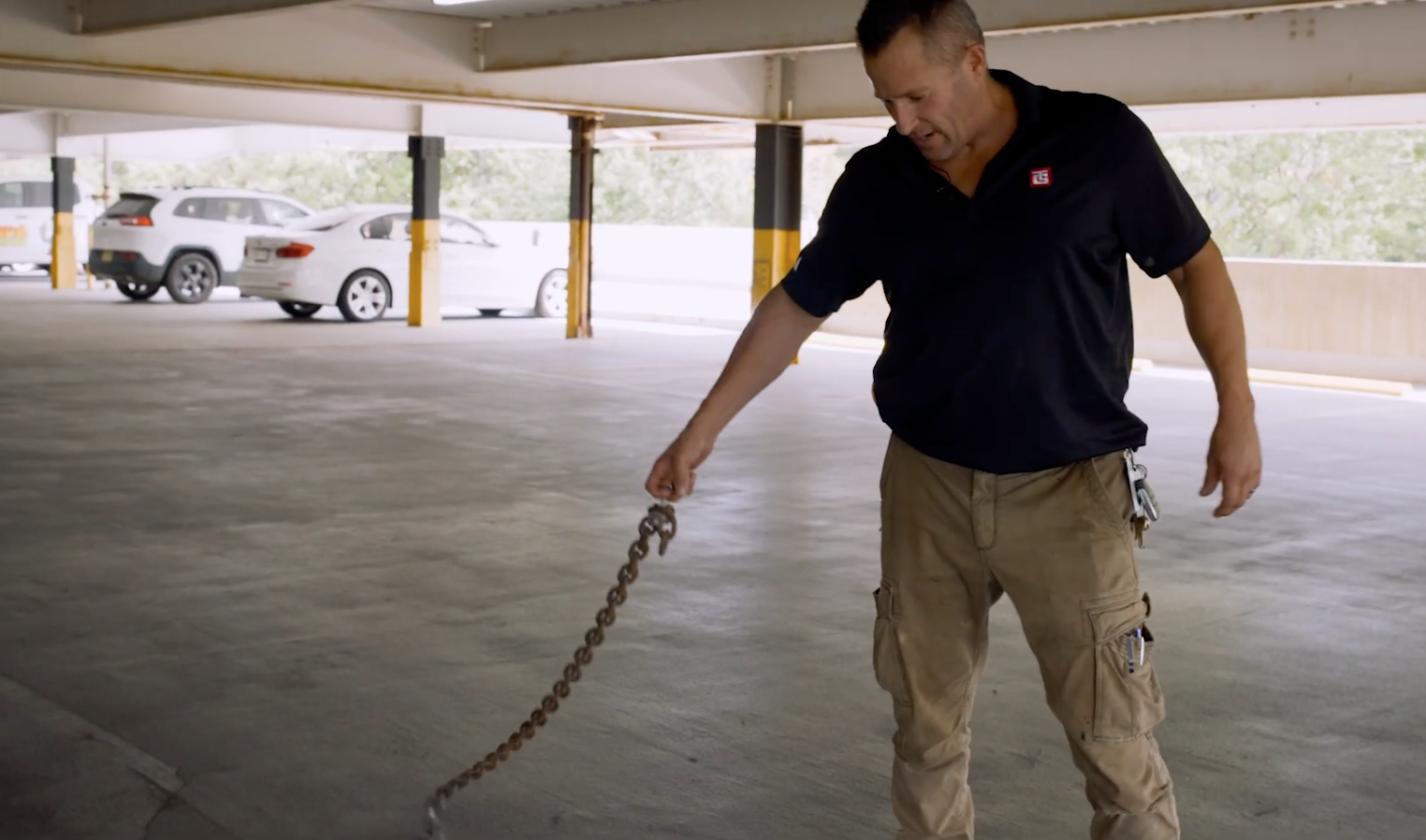
Chain dragging is a nondestructive evaluation method used to locate delaminated concrete. The concept is straightforward: an inspector drags a length of steel chain across the surface of a concrete slab and listens to the sound it produces. Solid, intact concrete returns a clear, sharp ringing tone. Delaminated concrete, where internal layers have separated due to corrosion or moisture intrusion, produces a distinctly hollow, drum-like sound.
The technique is governed by ASTM D4580, which outlines standard practices for measuring delaminations in concrete by sounding. Despite its simplicity, chain dragging requires a trained ear.
The difference between solid and delaminated concrete is audible, but ambient noise, surface conditions, and the depth of the delamination can all affect what the inspector hears. Experience matters. An operator who has surveyed hundreds of garage decks will catch deterioration that someone less familiar with the method might miss entirely.
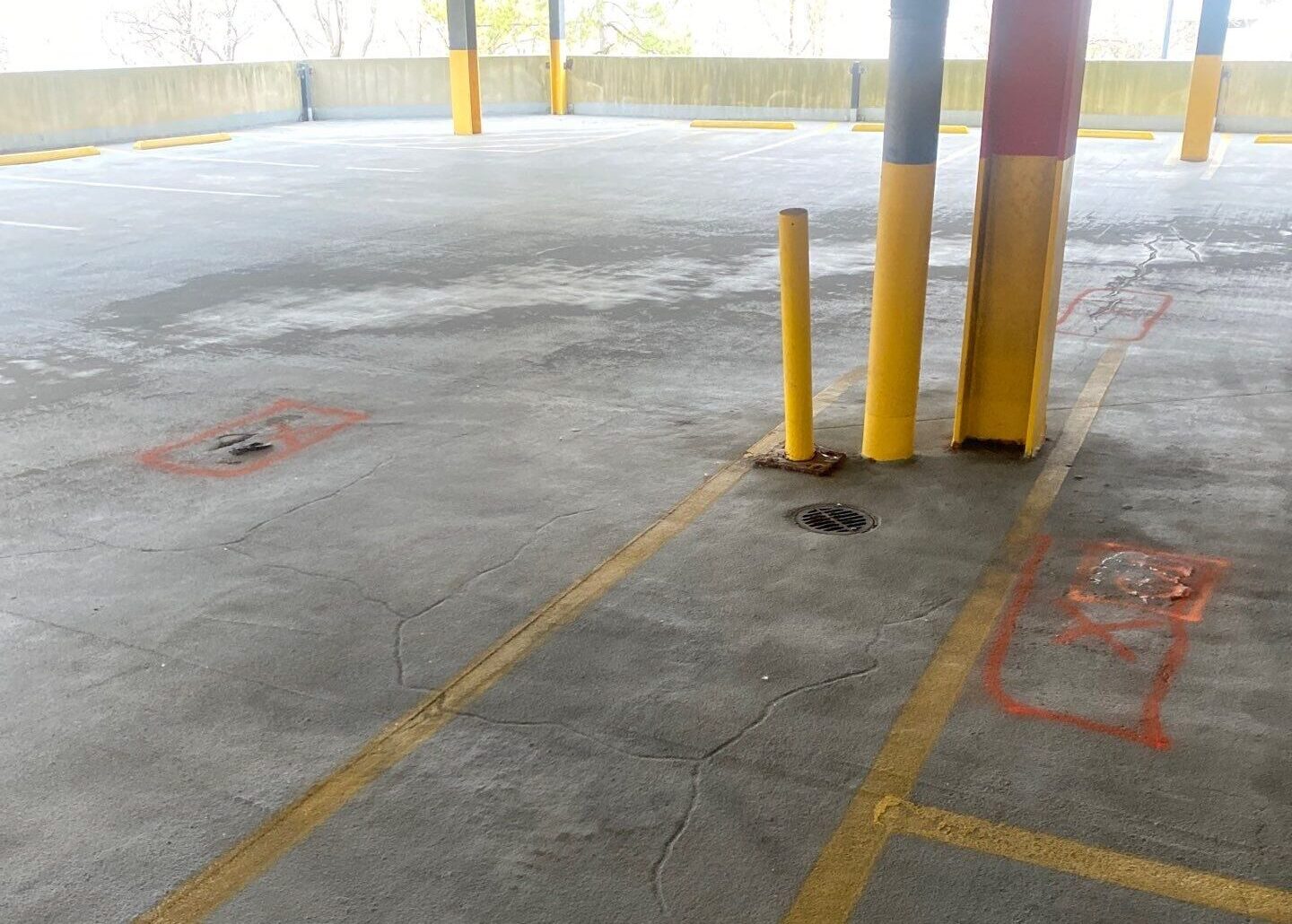
Once delaminated areas are identified, they’re marked directly on the slab surface, typically with spray paint, creating a visual map that guides the scope of the repair work. This survey is what determines how much concrete needs to be removed, where reinforcement has been compromised, and what the full extent of the restoration will involve.
Why It Matters in Parking Garages
Parking garages are uniquely vulnerable to the kind of damage that chain dragging detects. Vehicles carry road salt, moisture, and chemical contaminants onto every level of the structure. That moisture penetrates cracks and construction joints, reaches the embedded reinforcing steel, and initiates corrosion. As rebar corrodes, it expands. That expansion pushes against the surrounding concrete from the inside, creating internal separation, or delamination, long before anything is visible on the surface.
Left undetected, delaminated concrete continues to deteriorate. What starts as a subsurface separation becomes active spalling, where chunks of concrete break free from the slab.
In a parking garage with vehicles and pedestrians below, falling concrete is a direct safety hazard. Beyond the immediate risk, unchecked delamination spreads. What might have been a 500-square-foot repair becomes a 5,000-square-foot replacement if the problem goes unaddressed for a few more years.
This is why a thorough chain drag survey at the front end of a project is so valuable. It gives the engineering team and the contractor an accurate picture of the damage, which means the repair scope is based on actual conditions rather than assumptions. That accuracy translates to tighter budgets, more predictable timelines, and fewer surprises once demolition begins.
What Comes After the Survey
Once the chain drag survey maps out the deteriorated areas, the restoration work follows a defined sequence. Damaged sections are saw-cut along the marked boundaries and removed, often full depth down to the metal deck. New vented metal decking is installed to restore the structural substrate, followed by rebar and wire mesh reinforcement. Fresh concrete is then placed to return the slab to its original load-bearing capacity.
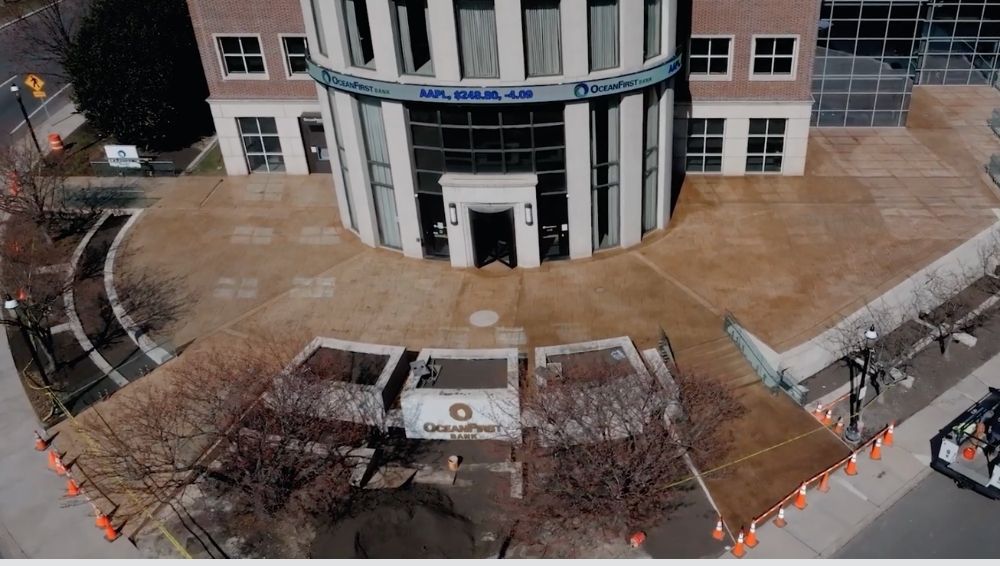
In a recent parking garage restoration project in East Rutherford, New Jersey, our team used this exact process to revive a four-level garage that remained fully operational throughout the work.
Chain dragging identified the areas requiring full-depth removal, and approximately 5,000 square feet of concrete was placed over three weeks. Because the garage stayed open, pours were scheduled on Saturdays to work within limited access windows. The project also included roughly 320 linear feet of expansion joint replacement on a single level alone.
Peter Decker, Site Superintendent at T.G. Basile, recorded a walkthrough of the project that shows the full process from survey through completion:
Watch the project walkthrough:
The Takeaway for Property Owners
Chain dragging is not new technology. It is not expensive, and it is one of the most reliable ways to understand what is actually going on inside your parking garage’s concrete before small problems become large, costly ones.
For property owners and facility managers responsible for aging structures, a professional delamination survey is the starting point for every informed maintenance decision. It turns guesswork into data and reactive repairs into planned restoration.
If your garage is showing signs of surface distress, or if it’s been several years since your last structural assessment, that survey is worth scheduling sooner rather than later. Work with a team you can trust and contact TG Basile today to see what 50+ years of experience can bring to your project.